Saturday, February 7, 2026
Why We Cut Our Dashboard From 5 Pillars to 3


What the UDA Convention Taught Us
At the UDA Convention in January, we spent time talking with practice owners and office managers about how they manage vendors and track practice health.
What stood out immediately was how little bandwidth they have for anything beyond daily operations.
One conversation changed how we think about the entire product.
A practice owner told us he had hired a dental billing company. He paid them every month for two years before his practice manager finally carved out time to review the results.
They were frustrated with what they found and canceled the contract.
When we asked why it took so long to check, his answer was simple and honest:
“I don’t have time to keep an eye on everything. I’m doing exams, reviewing treatment plans, managing staff, handling emergencies, dealing with insurance — and when I hire a company, I don’t have time to go check whether they’re actually doing the job.”
Two years. Paying for a service that wasn’t delivering.
Not because he didn’t care — but because he was buried in the day-to-day reality of running a practice.
That was the moment it clicked for us.
We had been designing for a practice owner who sits down, studies dashboards, and compares metrics across multiple categories.
That person doesn’t exist.
The real user barely has time to check whether the vendors they are paying thousands of dollars a year are actually doing anything at all.
We were optimizing for completeness.
They needed something that works even when nobody is watching.
How Five Became Three
We went back to the whiteboard and asked a different question.
Not “What are all the things we can measure?”
But “What are the actual decisions a practice owner makes?”
The answer mapped cleanly to the patient lifecycle:
- Get patients in the door
New patient acquisition and patient retention are two sides of the same coin. If you’re not growing and not keeping patients, that’s one problem — not two. - Get them on the schedule
Treatment acceptance and appointment management are connected. Unscheduled treatment and no-shows both point to the same gap: patients who should be in the chair, but aren’t. - Get paid for the work
Billing, claims, and collections all belong to closing the revenue loop.
Three pillars.
Patient. Scheduling. Collections.
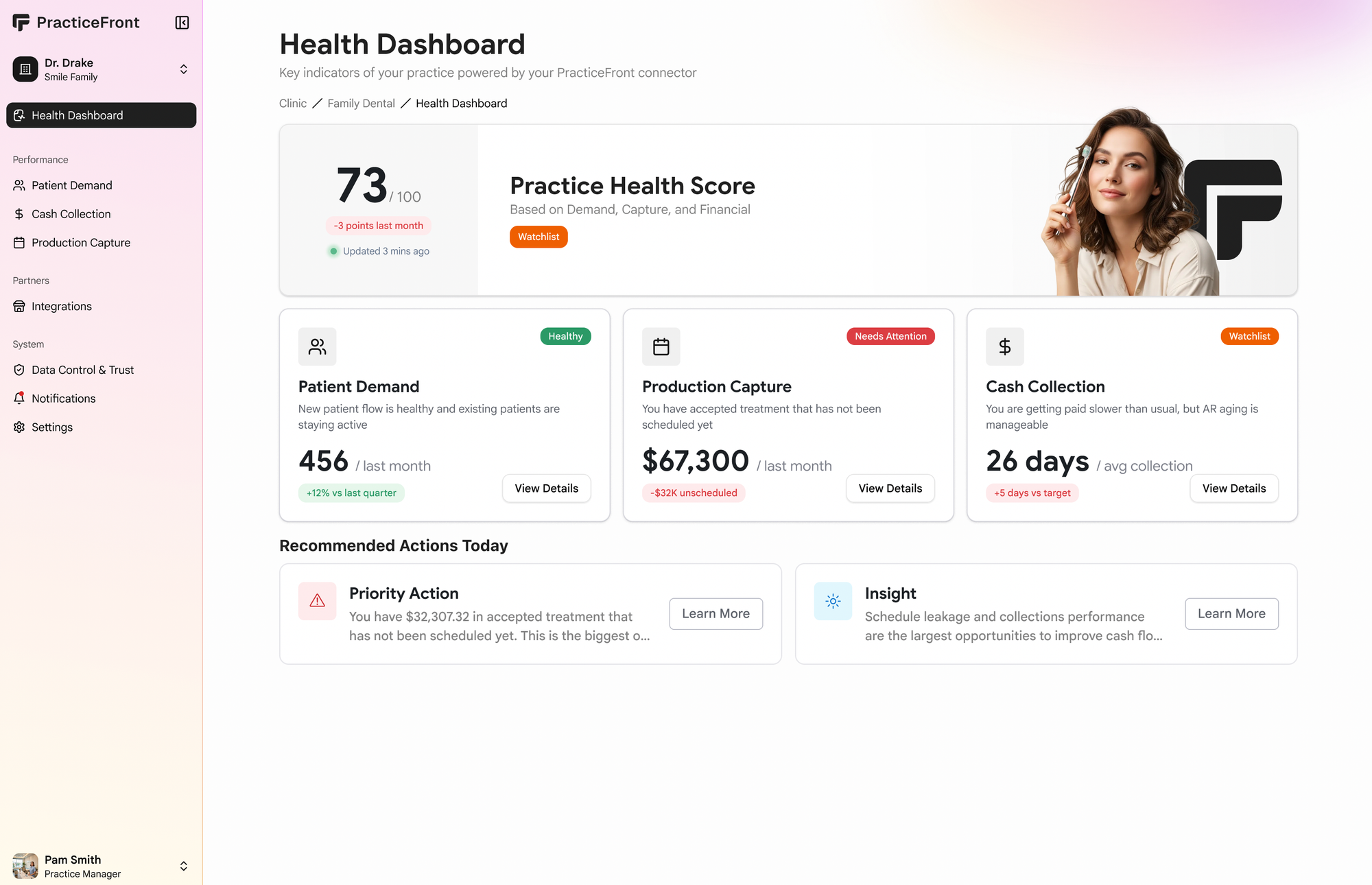
Each pillar represents a full stage of practice health.
Each one answers a single question:
“Do I have a problem here?”
What We Gained
Fewer pillars dramatically reduced cognitive load.
A practice owner can scan three indicators in under 10 seconds.
That’s the real design constraint — the 30 seconds between patients.
It also made partner recommendations clearer.
Instead of explaining which of five categories a marketing agency or billing service fits into, every partner maps cleanly to a single pillar.
Patient problem? Here are the partners that address patient problems.
Scheduling problem? Here are the partners that fix scheduling.
Collections problem? Same idea.
Simple, fast, and actionable.
What We Might Lose
Consolidation always carries risk.
When you merge new patient acquisition and patient retention into a single Patient pillar, you risk hiding an important nuance.
A practice could be great at attracting new patients, but terrible at keeping them.
Does a single pillar mask that problem?
That’s not a question we can answer in a conference room.
Why We’re Building a Prototype First
We’re not building the dashboard yet.
We’re building a prototype — a clickable Figma experience that looks and feels real, but costs days instead of months.
The prototype shows the three-pillar dashboard with realistic data. Each pillar can expand to reveal the underlying metrics.
We want to put this in front of real dentists and office managers and watch what happens.
Specifically, we’re testing three things:
- Comprehension
Do they understand what each pillar means without explanation? - Completeness
When they see the three pillars, do they ask, “What about X?”
If so, we need to know what X is. - Action clarity
When a pillar shows a problem, do they know what to do next?
If people consistently ask “What about X?”, we’ll know three pillars aren’t enough.
If nobody does, we’ll know the consolidation worked.
This is Running Lean in action — testing the riskiest assumption with the cheapest possible experiment before committing engineering time.
What This Means If You Run a Practice
We’re building PracticeFront to be the simplest way to know:
- If your practice is healthy
- And whether the vendors you’re paying are actually delivering results
That means obsessing over the foundation — not shipping fast, not adding features, but getting the framework right.
If three pillars is the right answer, your dashboard will be something you can check in seconds and actually trust.
If it turns out we need four, we’ll change it before you ever see it.
Either way, the answer will come from real conversations with real practice owners — not from our assumptions.
We’re building PracticeFront in public because the dental industry deserves better tools, built by people who actually listen.
If you run a practice and want to see the prototype when it’s ready, reach out.
Your feedback will directly shape what we build.